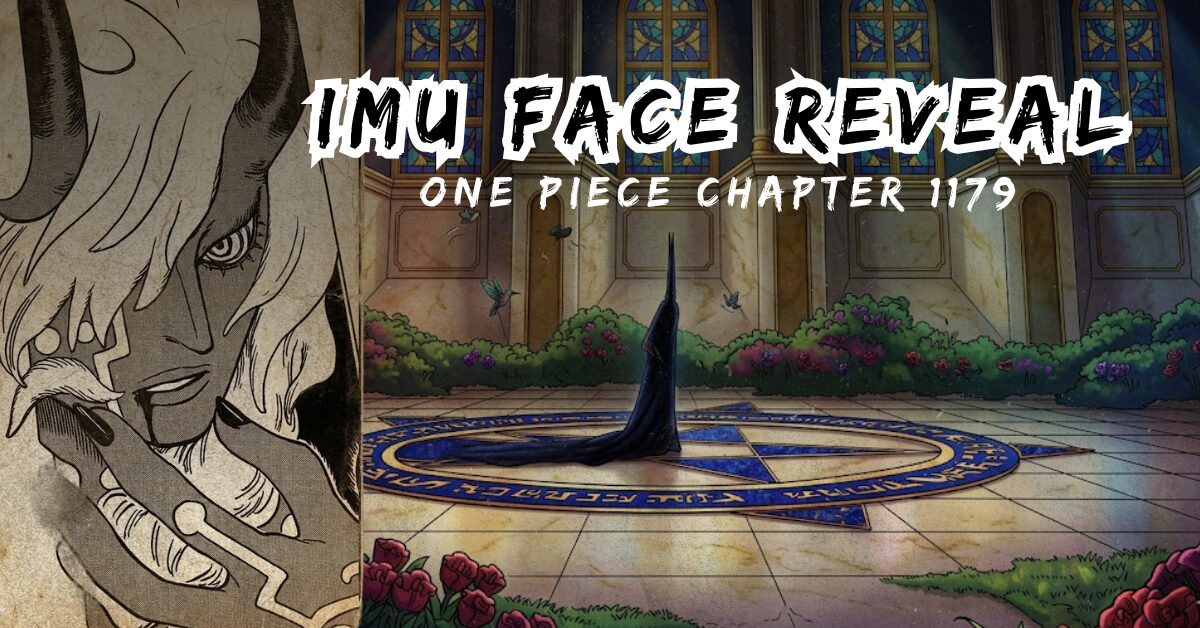
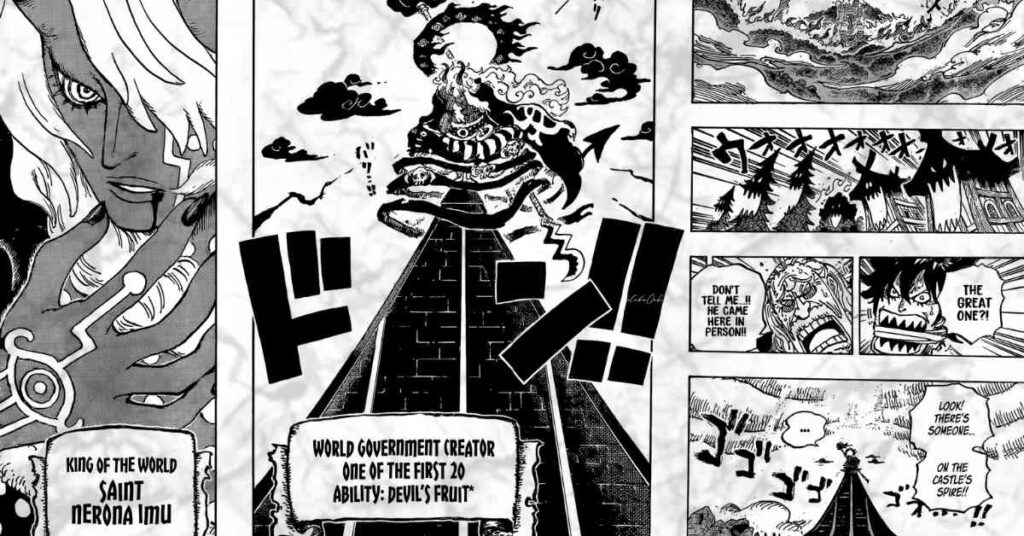
After 28 years, One Piece Chapter 1179 finally did it. Imu-sama’s face is revealed, his title is confirmed Saint Nerona Imu, King of the World and his entrance in Elbaph is, without question, one of the greatest villain introductions in manga history.
But here’s what bothers me about the community’s reaction.
Everyone is talking about the design. The horns. The devil tail. The white curly hair. The eye symbols printed on his hands. Fair enough — Oda delivered something genuinely unforgettable. But while fans are busy debating whether Imu looks cool enough, nobody is systematically breaking down what Imu’s Devil Fruit actually did in this chapter.
And Chapter 1179 gave us a lot to work with.
What Imu’s Devil Fruit Actually Did in Chapter 1179 — Panel by Panel
Let’s stop reacting and start analyzing. Here is every ability Imu demonstrated the moment he stepped into Elbaph:
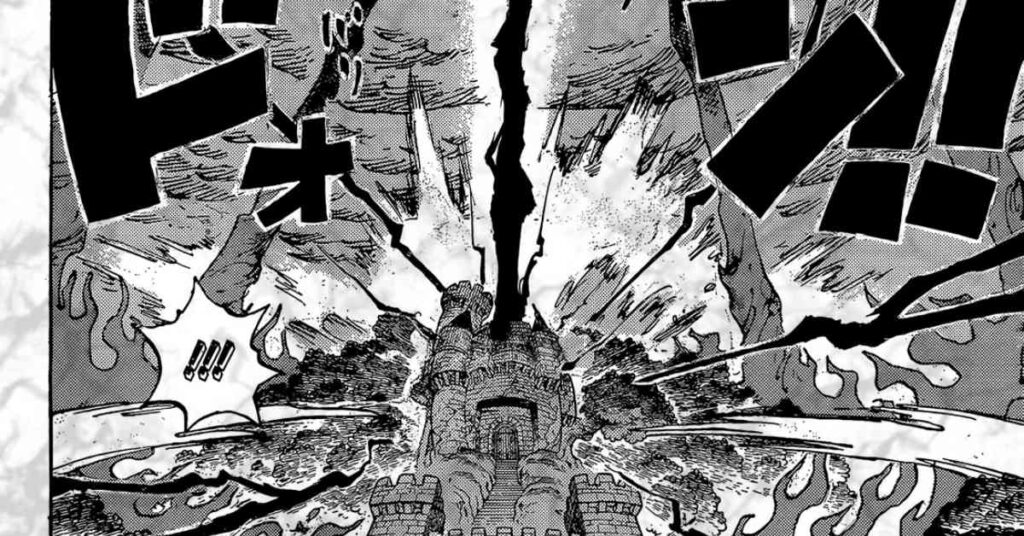
1. Environmental Demonic Transformation The instant Imu arrives, every tree, every house, every organic structure in Elbaph begins warping. Faces appear in wood. Buildings grow limbs. Structures move on their own. This is not a Logia. This is not a simple darkness ability. This is something that rewrites the nature of matter around him.
2. Sky Summoning Circles Here’s the detail most recap videos completely glossed over. Imu’s summoning circles don’t appear on the ground like every other magic-adjacent ability we’ve seen in One Piece. They form in the sky. That’s unprecedented in this series. It suggests his power operates on a completely different dimensional axis than anyone we’ve seen before.
3. Passive Conqueror’s Haki That Drops Giants This is the moment that hit me hardest personally. Imu doesn’t activate his Conqueror’s Haki like Luffy or Shanks — he simply exists and the giants around Elbaph start collapsing. Unconscious. Without him targeting them. The weaker ones drop instantly. Even the stronger giants are visibly struggling just to stand. For context — these are Elbaph giants. The strongest humanoid race in the One Piece world. And they’re folding passively.
That is not a normal Conqueror’s Haki flex. That is a different tier entirely.
4. Black Lightning on a Country-Wide Scale The black lightning falling across Elbaph isn’t just visual flair. Cross-reference this with Kaido’s Bolo Breath, Whitebeard’s tremors, Big Mom’s Prometheus — every Yonko-tier attack has a signature. Imu’s black lightning covers an area that dwarfs a normal island. This is AoE (area of effect) on a scale the series has never shown.
The Case for Mythical Zoan — Model: Demon King
Now let’s build the actual theory.
The fruit is listed in Chapter 1179 as Akoumainomi — roughly translated as “Devil Fruit” in the most literal sense. Akou = evil/demon. Mai = dance or presence. Nomi = fruit. The name itself is recursive — a Devil Fruit literally named “Devil Fruit.”
That kind of naming in One Piece is never accidental.
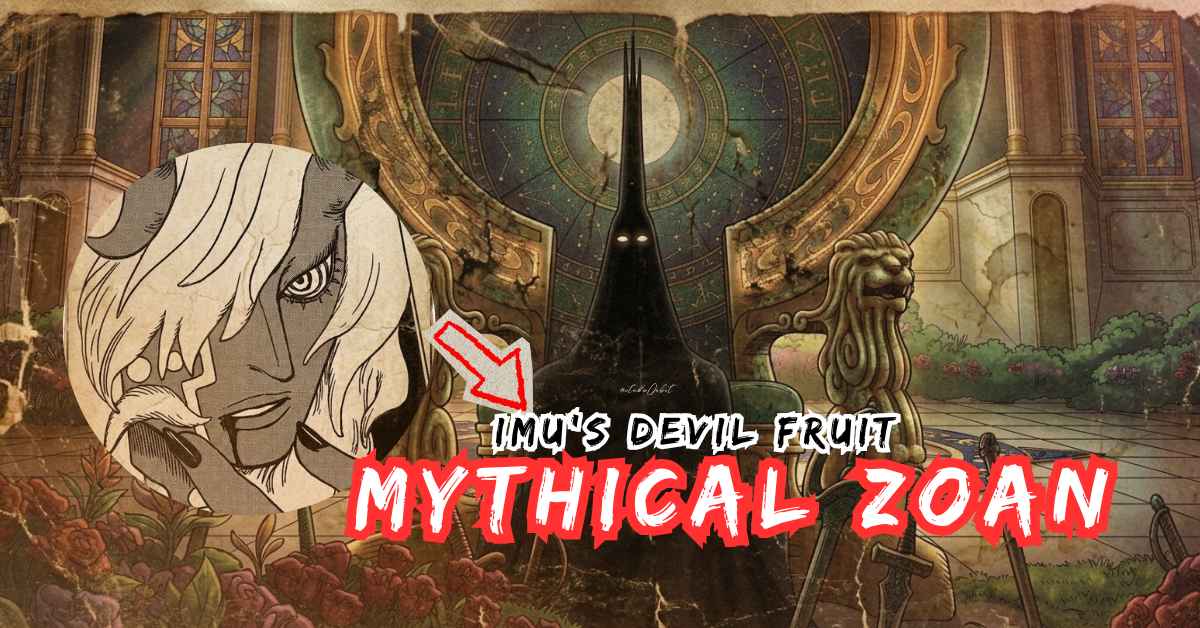
When you stack up everything Imu demonstrated — passive environmental corruption, sky-based summoning, country-scale AoE, and a Conqueror’s Haki that doesn’t need to be consciously deployed — the only fruit classification that explains all of it simultaneously is Mythical Zoan.
Specifically: Mythical Zoan, Model: Demon King (Maou).
Here’s why Paramecia doesn’t work: Paramecia abilities have defined rules and limitations. Imu’s power doesn’t feel rule-bound — it feels cosmological. It warps reality in multiple unrelated ways at once.
Here’s why Logia doesn’t work: Logia users become an element. Imu isn’t becoming darkness or shadow — he’s commanding an environment around him while remaining physically present and distinct.
Mythical Zoan, however, grants abilities inspired by the mythological nature of the creature. A Demon King, by mythological definition, commands lesser beings, corrupts the world around him, and operates outside normal power rules. Every single thing Imu did in Chapter 1179 maps directly onto that archetype.
The Bleeding Detail And Why It’s Imu’s Biggest Weakness
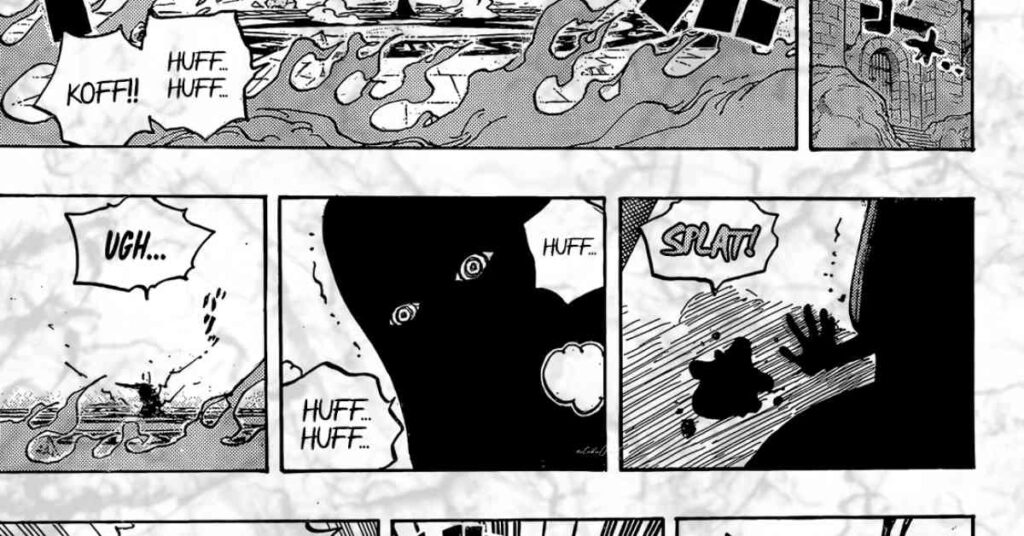
Here’s the thing most people are treating as a footnote: Imu bleeds when he leaves Mariejois.
The Five Elders practically begged him not to leave. They said things like “a god being shouldn’t descend to the lower world.” Imu arrives in Elbaph already bleeding.
My read on this — and I think this is the most important theory coming out of Chapter 1179 — is that Imu’s power is tied to the Holy Land’s energy source.
Mariejois sits at the top of the Red Line. The World Government’s entire structure feeds energy upward to that point. Mother Flame, the food shortages, Vegaforce — all of it is connected to a power infrastructure that Mariejois sits at the center of. Imu’s Devil Fruit, specifically the Demon King model, likely requires that power source to function at full capacity.
The moment he leaves, he’s running on a fraction of his actual strength. That bleeding isn’t dramatic flair. That is Oda planting the seed of how Imu eventually loses.
What This Means Going Forward
If this theory holds, the endgame of One Piece isn’t just “Luffy punches the final boss.” It’s strategically dismantling the power infrastructure of Mariejois — the Mother Flame, the Holy Land itself — before the final confrontation with Imu.
Which means Robin’s history research, Vegapunk’s notes, and whatever Cobra knew about Lily are all pieces of the same puzzle: how to cut Imu off from his power source and drag him down to a fair fight.
One Piece has been building toward this for 28 years. And Chapter 1179 just showed us the shape of the finish line.